


Teaching fundamentals of accounting to diverse cohorts
When Christine Gan handed her students printed templates and asked them to put their laptops away, she wasn’t being nostalgic — she was being strategic. But what happened next surprised her.
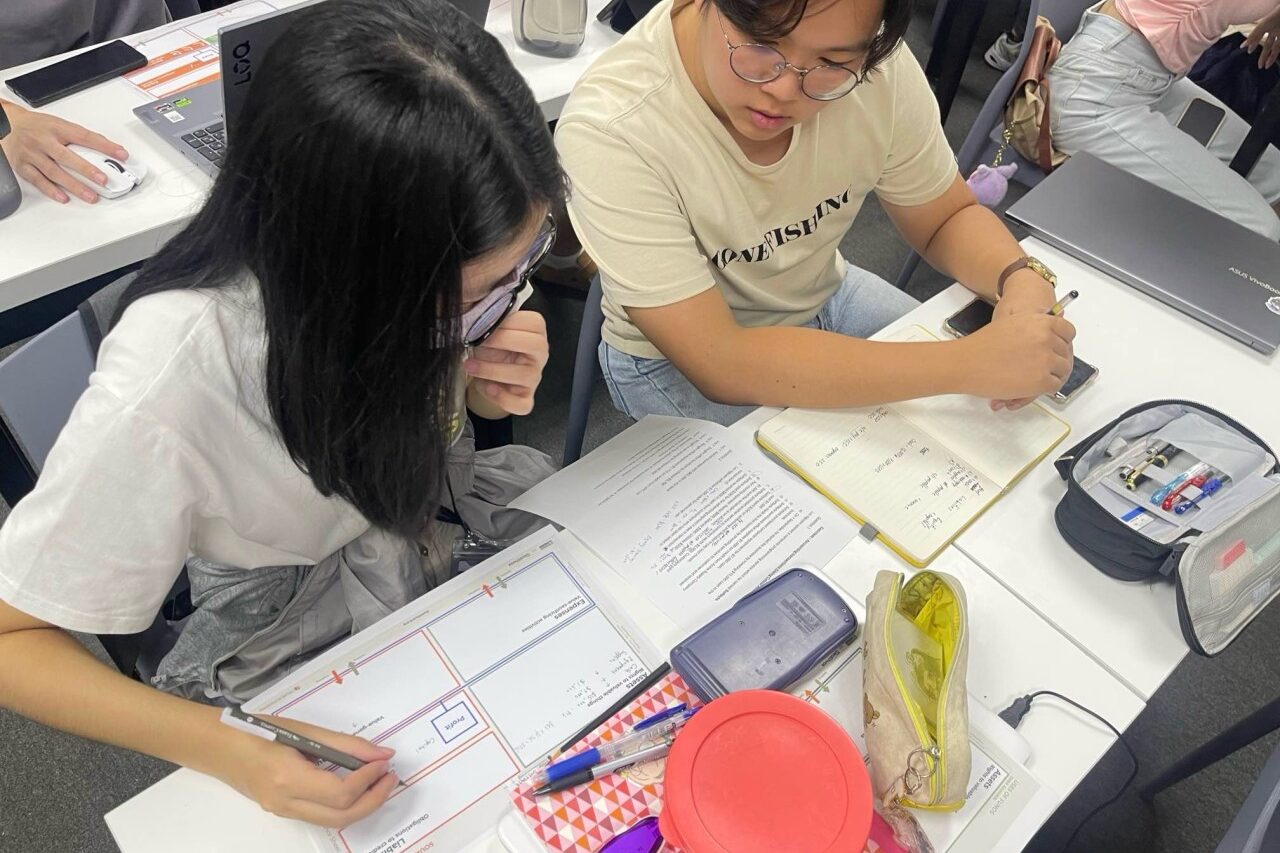
Teaching Fundamentals of Accounting in 2025 was both a challenge and a deeply rewarding experience. The class consisted of a mixed cohort of pre-university students, some of whom had studied accounting in high school and others who came from a science stream with no prior exposure to accounting. This diversity shaped every decision I made as an educator throughout the year.
The biggest challenge was not just what to teach, but how to teach accounting in a way that made sense to everyone. Students with prior knowledge often focus on memorising procedures, while newcomers struggle to understand why accounting works the way it does. Bridging this gap required going back to the fundamentals, not just the mechanics of debits and credits, but the “why” behind accounting — helping students see accounting as the language of business, not just a subject to pass.
Moving beyond rules and towards understanding
One of my main teaching goals was to help students truly understand:
- Why transactions are recorded in a certain way
- How accounting elements interact with one another
- Why accounting information matters in real business contexts
This is easier said than done, especially in a time when answers are just a prompt away.
Discovering Colour Accounting at the right time
During this journey, I came across the Colour Accounting Learning System from Wealthvox, which turned out to be a timely and transformative discovery. For non-profit educational institutions, Accounting Cafe offers complimentary teaching templates and interactive online activities designed to make accounting concepts visual, structured, and intuitive.
Colour Accounting is a way of teaching accounting, finance, and business in a graphical, plain-language format. Its core is the “BaSIS Framework” derived from Balance Sheet and Income Statement. It is used to explain accounting on one page in one day. Accounting literacy, financial literacy and business literacy are addressed in simple easy-to-understand terms.
For example, the balance sheet and income statement are presented in a single visual interface, with green and orange representing the debit and credit sides of the accounting framework. This way, students can see how the income statement is part of the balance sheet and how debiting and crediting affect each element.
What stood out to me most was how well it supported hands-on learning, something that feels increasingly rare in an era dominated by screens, AI tools, and instant answers.
Turning off laptops to turn on thinking
In a deliberate shift from the norm, I asked my students to turn off their electronic devices. I printed out the Colour Accounting templates and had them work through different scenarios using pen and paper and coloured templates.
This small change made a big difference.
Unlike online submissions, where many students understandably rely on ChatGPT or similar tools, working with a physical template forced students to think, recall, and apply concepts from first principles or from memory. They had to slow down, reason through each transaction, and physically write down their answers. There was no shortcut, only understanding.
The results and impact
The results were encouraging. Students began to say things like: “Accounting finally makes sense”, “I can see how everything connects now”, and “I understand why we do this, not just how.”
Students from non-accounting backgrounds gained confidence, while those with prior knowledge developed deeper conceptual clarity. Most importantly, many students became more engaged and less intimidated by accounting.
A note of appreciation
I am grateful to Wealthvox and Accounting Cafe for making these resources freely accessible to accounting educators. In a time when teaching can easily become automated or overly digitised, tools like Colour Accounting remind us of the power of active, tactile, and concept-driven learning.
Looking back at 2025, this experience reaffirmed an important belief of mine: sometimes, the most effective way forward in education is not more technology but better learning design, thoughtful restraint, and a return to fundamentals.
Accounting, after all, is not just about numbers. It is about understanding stories, decisions, and the logic that holds businesses together.
Suggested articles


Resources and Further Reading
York, T. (2023) ‘Myths, monsters and curses in accounting education‘, Accounting Cafe, 18 May. Available at: https://accountingcafe.org/2023/05/18/myths-monsters-and-curses/
Fundamentals of Accounting is a free Accounting Cafe course that uses the Colour Accounting Learning System with permission from its owners, Wealthvox Innovation Limited. It is available to accounting educators for use in non-profit educational institutions.

Christine Gan
With over 7 years of experience in the accounting and auditing industry and more than 15 years in higher education, Christine brings a blend of industry insight and academic leadership to the classroom.
At INTI International University and Colleges, she has headed accounting programs and managed the Australian and New Zealand degree transfer programs and program accreditation with professional bodies, including MIA, ACCA, CPA Australia, and ICAEW. Christine also launched INTI’s first e-commerce lab and drives student mobility projects.
She champions student-centred learning, builds industry partnerships, and creates pathways to empower young minds to become the next generation of business leaders and accounting professionals.
Part of the Pedagogy series
Join the Accounting Cafe community
© Accounting Cafe
How to cite this article: Gan, C. (2026) ‘Teaching fundamentals to diverse cohorts, Accounting Cafe, 30 April. Available at: https://accountingcafe.org/2026/04/30/teaching-fundamentals-to-diverse-cohorts/ (Accessed: [insert date])