


Meet Amara: An open educational resource with a difference
Many of us teach introductory financial reporting to students who are completely new to both accounting and university.

They arrive excited, nervous, ambitious and often overwhelmed. Many are adjusting to a new city, a new institution, a new friendship group and a much more independent way of learning. Some are studying in their second language. At the same time, they are being introduced to a discipline filled with unfamiliar terminology, interconnected concepts and ways of thinking that can feel abstract and difficult to access.
We face this challenge every year. Between us, we teach nearly 1,500 students drawn from programmes across the university. Like many accounting educators, we wanted to find new ways of helping students develop the strong foundations they need to succeed in financial reporting, particularly those who may be struggling to find their place academically or within a large institution such as the University of Manchester.
So, we created Amara.

Amara is an open-access, story-based introduction to financial reporting. It follows a first-year student entrepreneur through her first semester at university as she navigates friendships, group work, academic pressures, wellbeing challenges and the realities of running a small business.
Along the way, students encounter financial reporting concepts through Amara’s experiences. Instead of learning about profit, financial position, judgement, communication and decision-making through isolated exercises, they see these ideas emerge naturally through realistic situations and dilemmas. Our goal was to present financial reporting as a lived, human experience rather than a purely technical subject.
But sitting there in the café, another question surfaced more clearly than before.
What did the business look like right now?
Not over a month. Not over a semester. Just… today.
She opened her accounting app and began to picture it.
First, what the business had.
There was stock in her room, folded neatly in recyclable sleeves. There was cash in the new business bank account. And there were the things she used to run the business: her laptop, her phone, the packaging materials stacked under her bed. These were things the business controlled and relied on to make sales.
Her eyes drifted briefly around the café – the coffee machine behind the counter, the rows of cups, the tables and chairs filled with students. All things the business there depended on to operate.
Assets, she thought. Not just things you own for the sake of it, but things used to keep the business going. She smiled, remembering how Samir had described them as “basically anything the business would panic about losing,” which, she had to admit, captured the idea surprisingly well.
Using focus groups and a questionnaire, students told us that storytelling worked best when combined with other forms of learning. Students enjoyed the narrative, but they also wanted opportunities to test their understanding and apply their knowledge. As a result, the current version of Amara includes reflections, retrieval practice, multiple-choice questions, detailed feedback, and end-of-chapter challenges.
Which of the following best explains why Amara’s unsold clothing stock (inventory) is an asset?
- It has been purchased and may generate future benefits if sold.
That’s right, well done!
Amara’s clothing stock meets the IASB definition of an asset:
“A present economic resource controlled by the entity as a result of past events.”
- Present: The clothing exists now and is available for sale at the reporting date.
- Economic resource: The clothing has the potential to generate economic benefits because it can be sold to customers, generating cash and profit for the business.
- Controlled by the entity: The clothing is owned and controlled by Amara’s Threads. Amara decides what to sell, when to sell it, and for what price.
- As a result of past events: The stock is available because Amara previously purchased the clothing from suppliers. The purchase has already taken place, creating the resource the business now controls.
- It will definitely be sold in the next month.
- It increases Amara’s profit immediately.
- It belongs to Amara personally, not the business.
Which of the following best explains why unpaid supplier invoices are liabilities for Amara’s business?
- They represent future purchases Amara might make.
- They are amounts already agreed to be paid in the future.
- They reduce profit immediately when recorded.
Try again!
This is incorrect because a liability is defined by the existence of a present obligation, not by its effect on profit. In this case, the supplier invoice creates a liability because the business owes money as a result of a past purchase.
Whilst some liabilities arise alongside expenses that reduce profit (such as unpaid supplier invoices), others do not. For example, taking out a bank loan creates a liability but does not immediately affect profit.
- They are optional payments depending on available cash.
We were particularly excited by the opportunity to weave together disciplinary and well-being content. Throughout the resource, Amara faces many of the challenges that first-year students commonly experience: settling in, feeling overwhelmed, balancing competing demands, developing effective study habits, building friendships and learning when and how to ask for help. We wanted students to see that struggling at times is normal and that support is available.
Students told us they were curious to find out what happened next, that the story helped them make sense of challenging concepts, and that they appreciated seeing uncertainty and struggle normalised.
Reflection: Asking for academic help
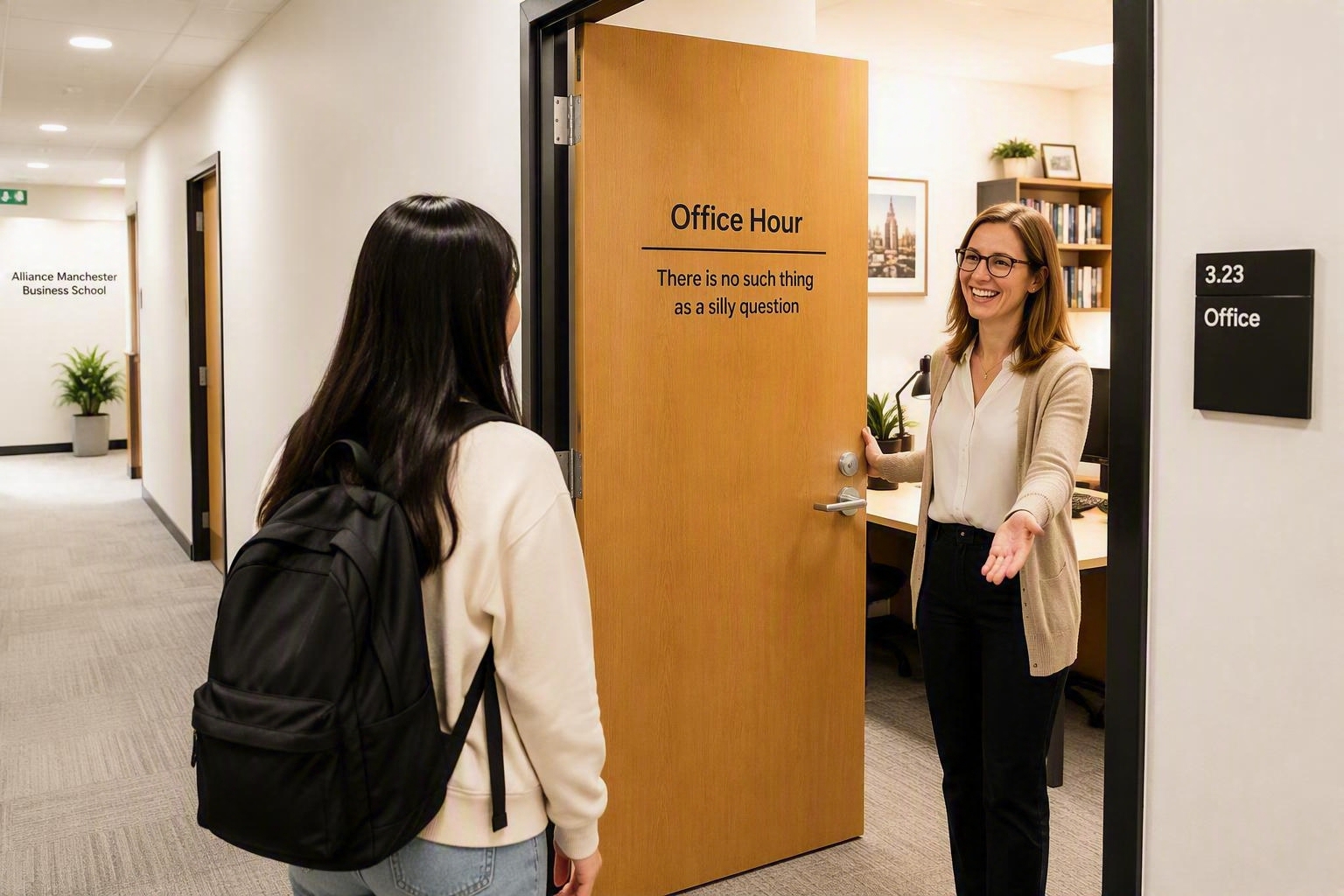
Amara’s experience shows that learning at university isn’t just about keeping up with content. It’s also about knowing when, and how, to ask for help and guidance.
👉 Pause, think and reflect:
How do you feel about approaching lecturers when something isn’t clear, or when feedback doesn’t make sense at first?
What worries might hold you back from asking questions in lectures, workshops, or office hours?
3.1 A confidence wobble

It had been one of those days.
She was tired. The kind of tired that made her eyes feel heavy as she rushed between lectures across campus. Global Marketing. Business Law. And of course, Financial Reporting.
By the time she stepped out into the grey Manchester afternoon, her shoulders ached from the weight of her overstuffed bag and her brain felt stretched thin. Then her phone buzzed.
The resource is hosted by Pressbooks as an open educational resource and is freely available to anyone, both educators and students. It has eight short chapters, each focusing on specific financial reporting themes while continuing Amara’s story. Educators can also clone and adapt the resource for local contexts, incorporating institution-specific support services, images, examples, and context.
Like us, you may use it as a supplementary resource alongside lectures, seminars, learning materials, and textbooks, directing students to relevant chapters as the term progresses. Alternatively, you may wish to embed it more fully within a module, using the narrative to stimulate discussion, reflection, engagement with key concepts, and perhaps even assessment. That is something we are hoping to explore more ourselves in the future.
We would love to hear what you think. If you decide to use Amara with your students, adapt it for your own context, or have ideas for its future development, please get in touch.
Exploring the Foundations of Financial Reporting: Amara’s Journey as a Student Entrepreneur – Simple Book Publishing
Alison Zimmer
Alison is a Lecturer in Accounting at Alliance Manchester Business School and a Senior Fellow of Advance HE. She is passionate about helping students succeed in accounting, using creative, compassionate and evidence-informed approaches to build confidence, engagement and belonging. Her interests include accounting education, assessment and feedback, student wellbeing, and the development of Graduate Teaching Assistants and future educators. Through her teaching, scholarship and leadership, Alison seeks to create learning environments where students and colleagues feel supported, valued and able to thrive.

Oluwatoyin Dosumu
Toyin is a Senior Lecturer in Accounting and Finance at Alliance Manchester Business School and a Senior Fellow of Advance HE. Her work focuses on creating opportunities for people to develop confidence, build meaningful connections, and cultivate a sense of belonging within educational and professional environments. She is particularly interested in mentoring, storytelling, cultural intelligence, identity, and inclusive leadership, and how these shape learning, career development, and organisational culture. Through her teaching, scholarship, and leadership, Toyin creates environments where people feel valued, supported, and empowered to realise their potential.
Part of the Pedagogy series
Join the Accounting Cafe community
© Accounting Cafe
How to cite this article: Zimmer, A. and Dosumu, O. (2026) ‘Meet Amara: An open educational resource with a difference’, Accounting Cafe, 20 October. Available at: https://accountingcafe.org/2026/10/20/meet-amara/ (Accessed: [insert date])