


Learning styles are dead. Long live learning strategies.
Posted by Toby York. Last updated: November 29, 2025
Nine out of ten teachers believe that students learn better when taught in their preferred learning style (Newton & Salvi, 2020)Newton, P. M., & Salvi, A. (2020). How common is belief in the learning styles neuromyth, and does it matter? A pragmatic systematic review. Frontiers in Education, 5, 602451. yet the literature suggests this “matching hypothesis” has almost no impact on achievement.
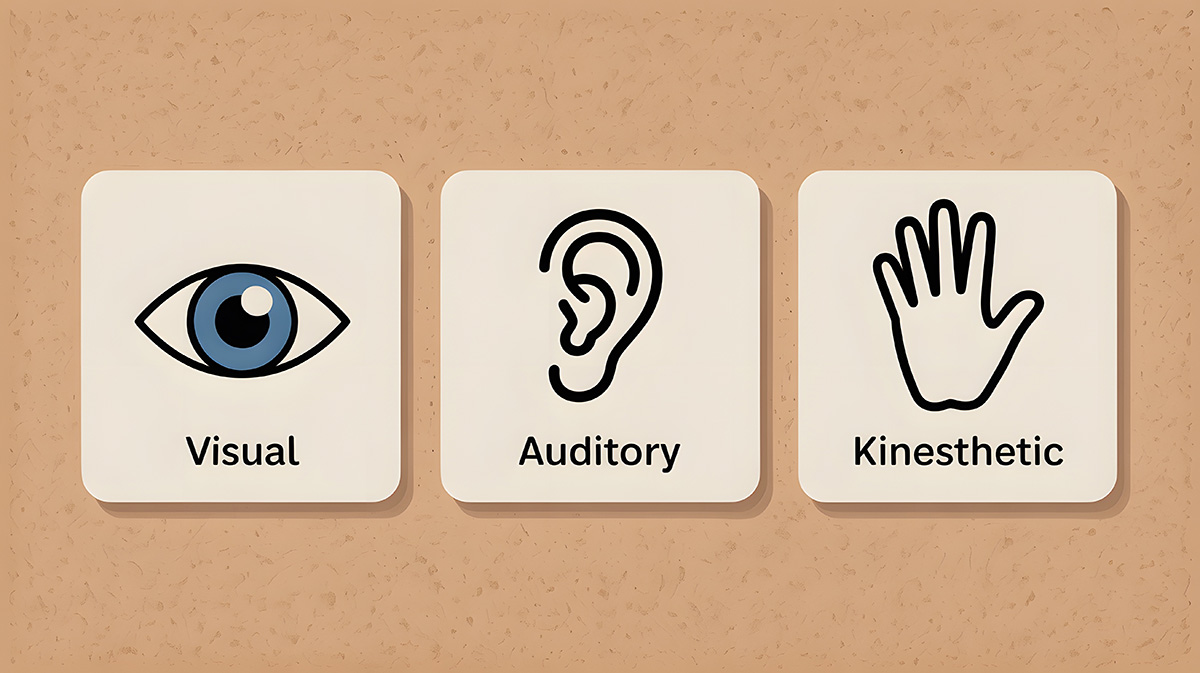
Nine out of ten teachers can’t be wrong, can they?
Learning theorists have research and evidence on their side, but teaching practitioners appear unwilling to let go of learning styles. This is odd and it matters enormously for how we design courses and support students.
Until recently, it was common to find learning styles in teacher training courses and they can still be found on university websites and in the common imagination. More recently, exchanges between researchers and teachers have got a little tetchy. This from Donald Clark is fairly typical:
It would not be far wrong to describe it [learning styles] as a theoretical virus that has infected education and training on a global scale, kept alive by companies peddling CPD to teachers.
Donald Clark, Plan B Blog
In his Plan B BlogClark, D. (2012). Fleming: VAKuous learning styles {Blog post}. Donald Clark Plan B., he describes it as “a crude categorisation, unresearched and taken from a field of learning widely regarded in academic and professional psychology as bogus” and “despite serious criticism from almost every angle…this pop-psychology has become deeply rooted in education.”
Might each side in this fractious debate be talking about entirely different things? Recent research (Hattie & O’Leary, 2025)Hattie, J., & O’Leary, T. (2025). Learning styles, preferences, or strategies? An explanation for the resurgence of styles across many meta-analyses. Educational Psychology Review, 37:31offers a possible way forward, but first, let’s take a look at the origins of learning styles and the evidence for them.
The origins of learning styles
Learning styles emerged from neuro-linguistic programming (NLP) in the 1970s, created by Richard Bandler and John Grinder. The backstory to NLP is colourful. Bandler, a cocaine addict, was arrested for murder when a prostitute was shot with his gun. He and his cocaine dealer pointed fingers at each other; the jury couldn’t decide who pulled the trigger, and he was acquitted. Researchers have also widely discredited NLP, but we’re focussing only on learning styles.
At the heart of NLP was a pseudoscientific idea Bandler and Grinder called PRS, the Primary Representational System, which was essentially learning styles. Since the early 1980s, learning styles have taken root and proliferated in training and education. In a 2004 reviewCoffield, F. J., Moseley, D. V., Hall, E., & Ecclestone, K. (2004). Learning styles and pedagogy in post-16 learning: A systematic and critical review. Learning and Skills Research Centre.commissioned by the UK government, Professor Frank Coffield and colleagues identified 71 learning styles theories after excluding those deemed insubstantial. Each model was examined for evidence of internal consistency, test–retest reliability, construct validity, and predictive validity. Only three of the 13 most influential models came close to meeting these basic criteria. Coffield’s team concluded, “We therefore advise against pedagogical intervention based solely on any of the learning style instruments.”
What the evidence shows
Over 20 years later and we’re still debating their merits. Hattie and O’Leary’s meta-analysis examined 17 separate meta-analyses covering nearly 700 studies. They found two distinct types of research:
Matching studies that test whether students learn better when teaching matches their preferred style. The evidence is clear that matching has virtually zero impact on learning.
Correlational studies that examine relationships between learning styles and achievement. They found students who report certain preferences show modest differences in achievement. So, perhaps something is going on, but what?
In a recent LinkedIn discussionJohn Whitfield MBA, LinkedIn post, October 2025, organisational innovation professor Jhon Cano commented that learning styles “can act as catalysts to capture attention and engagement, especially when dealing with complex content.” He cited research by Ergün and others (2020)Ergün, Esin & Kurnaz, Fatma. (2020). Exploring the Predictive Role of E-Learning Readiness and E-Learning Style on Student Engagement. Open Praxis. 12. 175showing that adaptive e-learning systems incorporating learning styles increased behavioural, emotional, and cognitive engagement. There was pushback, suggesting that factors such as varied teaching methods or greater attention to student needs, were responsible for these improvements.
The exchange is worth unpacking.
What do people mean by “Learning Styles”?
Here’s where much of the confusion lies. When people discuss learning styles, they’re often referring to different concepts.
Research has thoroughly debunked the claim that, for example, visual learners learn better from visual instruction and auditory learners learn better from auditory instruction. In fact, Donald Clark warns us: “It’s not just that learning styles are a waste of time…they’re actually quite dangerous. That kid who isn’t reading…that’s the very kid who needs to be taught to read.”
He adds, “When we label a struggling reader as a kinaesthetic learner and avoid giving them reading practice, we deny them the very instruction they need most. The label becomes an excuse for educational neglect.”
But there’s another claim that students prefer to learn in certain ways, and this is probably true. I heard a teacher say, “I personally dislike learning from video and much prefer transcripts. It doesn’t mean I can’t do it — it means that I’m going to act like a recalcitrant child to find a way around it.”
Furthermore, whether you work better in the morning or afternoon, with music or silence, in groups or alone, are contextual preferences, but calling them “learning styles” confuses the issue.
Here’s a useful reframe supported by evidence and helpful to learners that might help us get past the argument:
Different tasks require different strategies, and students need to develop a flexible repertoire.
Stuart Pedley-SmithPedley-Smith, S. (2011). Learning styles – don’t work or do they?, {Blog Post}, Pedleysmiths Blogbelieves that knowing about learning styles is helpful, not to label learners, but to broaden their horizons and give them alternative ways of learning.
The Hattie and O’Leary paper says many studies “confuse learning styles with learning strategies.” When researchers find that “deep learning” approaches correlate with achievement, it’s about how students engage with material.
Maybe, when teachers say matching learning styles works, they mean: “When I vary my teaching methods and pay attention to how individual students engage, they learn better.” This is likely true, but it’s not the same as matching individual learners to a fixed learning style.
If we believe students have fixed learning styles that need to be matched, we might pigeonhole them. If we recognise they need varied strategies for different tasks, we can teach them adaptability.
As one educator observed: “Understanding learning styles is about creating more choice and flexibility, not labelling yourself.”
Why the myths persist
So why do 93% of teachers still believe in learning styles despite the evidence? Several factors contribute:
It feels true. We all have experiences of learning clicking when presented in a particular way. The problem is confirmation bias: we remember the hits and forget the misses.
It’s appealingly simple. Learning is complex. “You’re a visual learner” offers a straightforward explanation and seemingly actionable advice.
It affirms individuality. We want students to be seen as unique individuals with distinct needs. Learning styles appear to honour that without being overly complicated.
It’s commercially promoted. As Coffield noted, a commercial industry has been built to offer advice to teachers, tutors, and managers on learning styles, much of it consisting of “inflated claims and sweeping conclusions that go beyond the current knowledge base.”
The nuanced truth is harder to communicate. “Learning styles don’t work, but varied teaching methods, metacognitive strategies, and attention to task demands do” is accurate but doesn’t fit on a poster.
Perhaps most importantly, when teachers use a “learning styles” framework, they’re doing something helpful by varying their teaching, being attentive to individual students, and providing multiple representations.
What should we do instead?
There’s robust evidence that helping students learn more effectively involves shifting from fixed-style matching to teaching flexible strategies that align with task demands. Hattie and Donoghue (2016)Hattie, J., & Donoghue, G. M. (2016). Learning strategies: A synthesis and conceptual model. NPJ Science of Learning, 1(1), 1–13.identified over 400 learning strategies and found that their effectiveness varies depending on where students are in their learning journey:
For surface learning (acquiring facts and knowledge):
- Organising and summarising
- Spaced practice
- Rehearsal and memorisation
- Deliberate practice
For deep learning (developing understanding and connections):
- Relating ideas to prior knowledge
- Seeking clarity through questioning
- Self-verbalisation
- Elaboration
For transfer (applying knowledge in new contexts):
- Identifying similarities and differences
- Pattern recognition
- Metacognitive reflection
Self-regulation is perhaps the most crucial skill. It helps students to choose appropriate strategies and evaluate whether they’re effective. As the research shows, deep approaches to learning correlate positively with achievement, while surface approaches correlate negatively.
What if we stopped asking “what’s your learning style?” and started asking “what learning strategy fits this task best?”
John Whitfield MBA, in a LinkedIn post, October 2025
Long live learning strategies
Learning styles as fixed traits requiring matched instruction deserve to die. But the intuition that students differ and benefit from varied, responsive teaching deserves to live.
The path forward involves:
- Forget the matching hypothesis and remove it from teacher training and educational materials
- Teach students a repertoire of learning strategies rather than labelling them with fixed styles
- Vary teaching methods because different content and tasks benefit from different representations
- Develop metacognitive awareness so students can monitor and adjust their approach
- Focus on what works rather than what feels intuitively true
As Hattie and O’Leary conclude: “Learning is most effective when students develop cognitive and metacognitive strategies tailored to task demands rather than teaching them according to their learning preferences.”
Further reading and resources
Clark, D., & Helmer, J. (2011). Learning styles. Great Minds on Learning, Season 3, Episode 13. [Podcast]. Accessed 27 November 2025.
Coffield, F. J., Moseley, D. V., Hall, E., & Ecclestone, K. (2004). Learning styles and pedagogy in post-16 learning: A systematic and critical review. Learning and Skills Research Centre. Accessed 27 November 2025.
Ergün, Esin & Kurnaz, Fatma. (2020). Exploring the Predictive Role of E-Learning Readiness and E-Learning Style on Student Engagement. Open Praxis. 12. 175. Accessed 27 November 2025.
Hattie, J., & Donoghue, G. M. (2016). Learning strategies: A synthesis and conceptual model. NPJ Science of Learning, 1(1), 1–13. Accessed 27 November 2025.
Hattie, J., & O’Leary, T. (2025). Learning styles, preferences, or strategies? An explanation for the resurgence of styles across many meta-analyses. Educational Psychology Review, 37:31. Accessed 27 November 2025.
Kavale, K. A., & Forness, S. R. (1987). Substance over style: Assessing the efficacy of modality testing and teaching. Exceptional Children, 54(3), 228–239. Accessed 27 November 2025.
Newton, P. M., & Salvi, A. (2020). How common is belief in the learning styles neuromyth, and does it matter? A pragmatic systematic review. Frontiers in Education, 5, 602451.
Pedley-Smith, S. (2011). Learning styles – don’t work or do they? Pedleysmith Blog. Accessed 27 November 2025.
© Accounting Cafe
Part of the Pedagogy series
Join the Accounting Cafe community
How to cite this article: York, T. (2025). Learning styles are dead. Long live learning strategies. Available at: https://accountingcafe.org/2025/11/27/learning-styles-are-dead-long-live-learning-strategies/ Retrieved: [insert date].