


Build, connect, audit: A business process simulation
Posted by Toby York. Last updated: September 23, 2026
When I first taught Accounting Information Systems and Auditing, I inherited workshops that were largely delivered through teaching slides. So I created a business process simulation to introduce students to revenue, expenditure, conversion, and management cycles, together with the documents, records, and internal controls associated with each cycle.

The content of slides matters. However, explaining a business cycle is not the same as helping students understand how one actually works. Also, the four cycles are inherently connected.
Thus, I replaced the conventional workshops with a three-stage Business Process Simulation group activity. I used the activity with a cohort of around 150 students, working in groups of approximately ten. Instead of giving students a pre-set case to analyse, I asked each group to create, develop, and audit its own business. The sequence was simple:
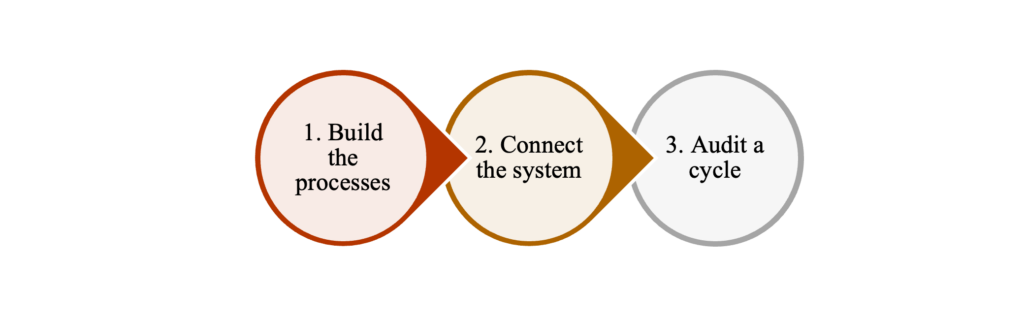
Students were free to choose the type of business and product, but the underlying tasks were common to each group. For each stage, I provided students with a structured guide and a worked example to specify what to consider and what output was required. In Stages 2 and 3, groups retained the business created in Stage 1 and extended it based on the requirements specified in the guides.
Stage 1: Build the processes
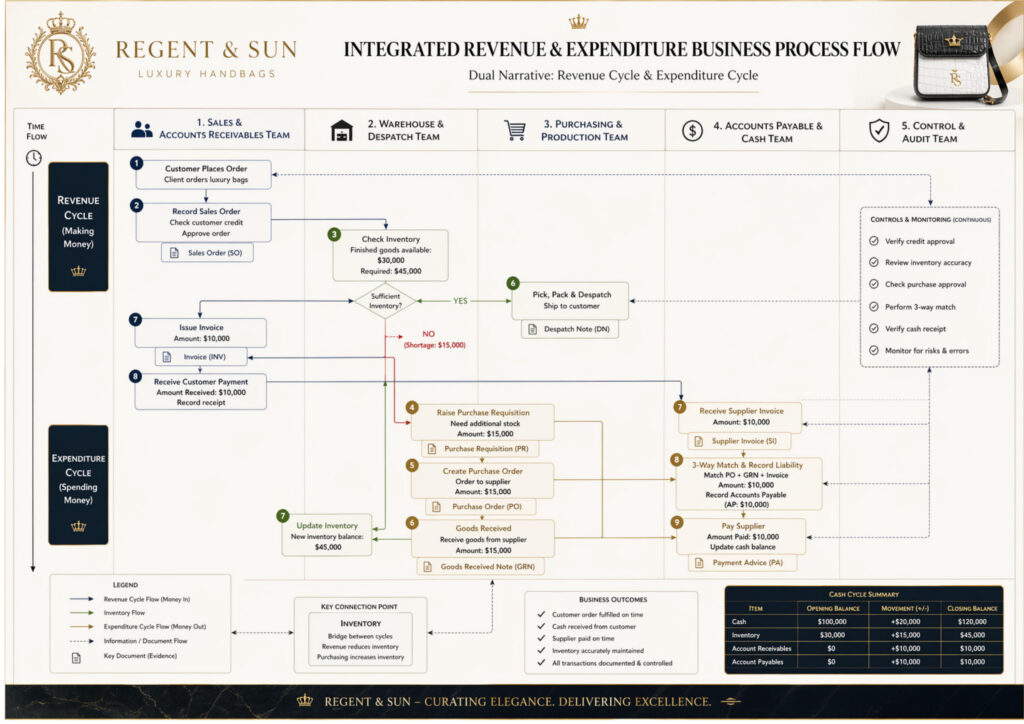
In the first stage, each group created a business. Students had the discretion to decide the nature and structure of the business, as long as they reached an agreement within their own group. As a result, the businesses created covered various types, including those selling luxury handbags, plants, candles, food products, office equipment, and so on. Within each business created, students divided themselves into functional teams, such as sales/accounts receivable, purchasing, warehouse/operations, accounts payable/cash, and control or audit, and allocated specific responsibilities. This allowed each group member to contribute within their assigned role.
Students then developed a business transaction scenario covering the revenue and expenditure cycles and worked out how their business would process a customer order, approve credit, deliver goods or services, invoice the customer, and collect payment. They also considered how purchasing would be initiated, suppliers selected, goods received, supplier invoices processed, and payments made.
Based on the scenario developed, groups were required to identify the documents and accounting records produced along the way and create a process-flow diagram; this was the major output of Stage 1, which they were required to submit to me for formative feedback. In the diagram, they were encouraged to show how relevant accounts, such as cash, inventory, receivables, and payables, had changed as transactions occurred. The point was to make students actively consider questions that may disappear when a business cycle is presented neatly on a teaching slide, for example, who is responsible for this? What information should be recorded? What documents should be generated? What could go wrong?
Stage 2: Connect the system
The second stage asked students to keep the same business and add the conversion and management cycles. This was where the activity became much more interesting. Students could no longer treat revenue, expenditure, inventory, and payroll as four separate textbook topics. They need to show how one transaction influences relevant cycles simultaneously within their own business.
For example, a customer order might generate a production requirement. Production planning establishes the materials and labour needed. Insufficient materials trigger purchasing. Employees’ workload is recorded, which affects payroll and product costing. Finished production updates inventory and allows the original customer order to be fulfilled.
Each group was required to submit a written business scenario and one integrated process-flow diagram showing the essential relationships among all four cycles. They also incorporated controls such as credit approval, purchase authorisation, approved timesheets, quality checks, and reconciliations.
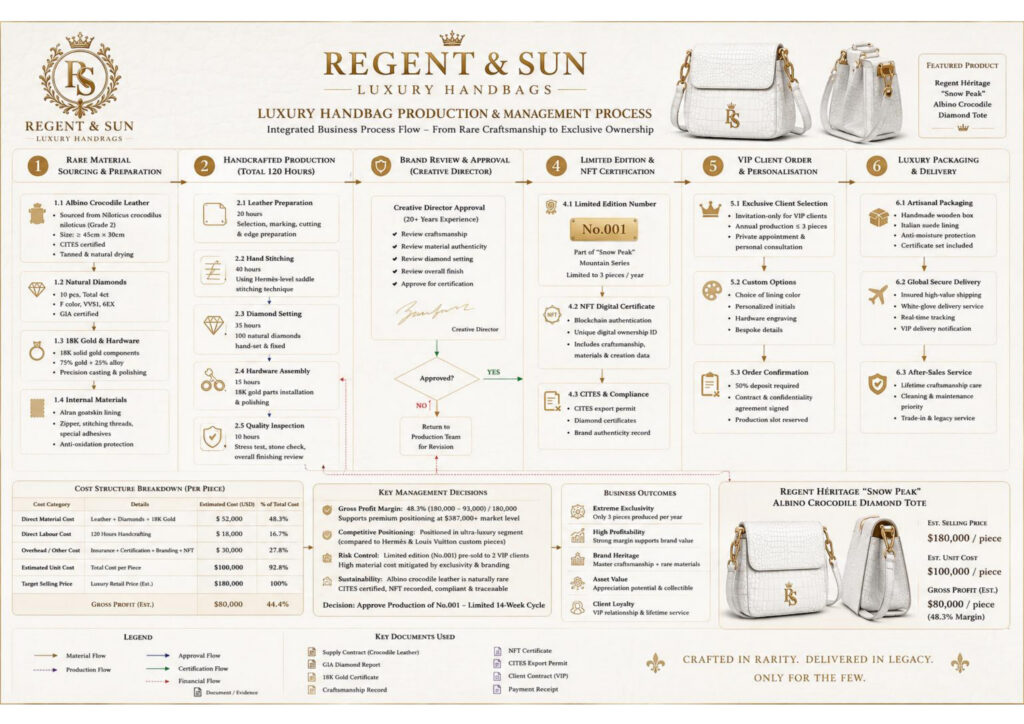
Importantly, I provided each group with formative feedback on their Stage 1 submission before asking them to tackle this more complex task. The improvement from Stage 1 to Stage 2 was visible. In the Stage 2 submission, nine of the 15 groups achieved 90 (out of 100) or above (compared with 5 of 15 in Stage 1). One group, for example, improved from 75 to 90. None of the marks contributed to the students’ final module grades. Their willingness to revisit and improve their work therefore mattered to me more than the numbers themselves.
Stage 3: Audit a cycle
The third and final stage introduced auditing. Each group was randomly allocated one of the revenue, expenditure, conversion, or management cycles and asked to audit it within its own business from an auditor’s perspective. Each group considered its assigned cycle by focusing on the associated transactions, records, documents and controls. For example, a group allocated the revenue cycle might examine customer orders, credit approval, despatch, invoicing, accounts receivable, and cash collection. I gave students the following chain to work through:
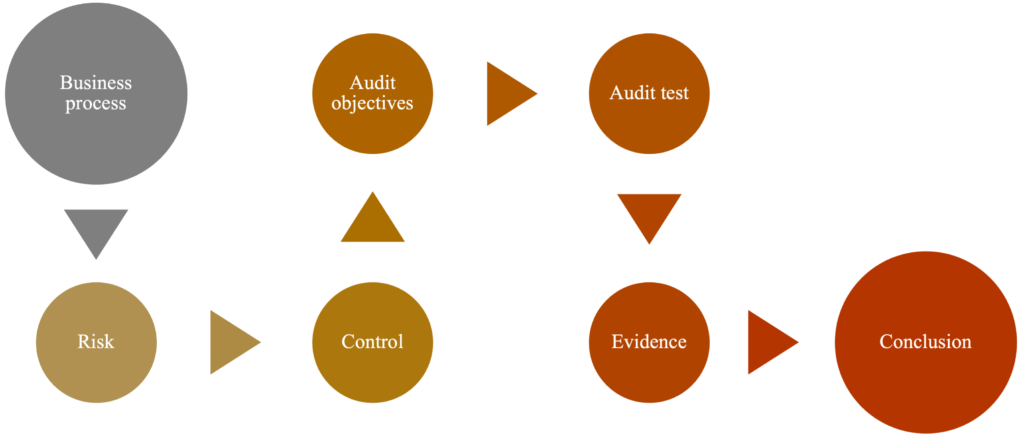
They considered audit objectives including occurrence, completeness, accuracy, posting, classification, and timing. For each objective, they identified what could go wrong, the control that should address it, an appropriate audit procedure, and the evidence an auditor would inspect.
This stage produced a useful change of perspective. Students were no longer designers of an accounting information system. They became auditors asking whether the system they had developed could be trusted. For me, that was the pedagogical value of the sequence. Students needed to first understand the business process before they could meaningfully evaluate its controls, risks, and audit evidence.
Overall, the three-stage group activity was formative. However, I gave groups indicative marks and detailed written feedback on the Stages 1 and 2 submissions so that they could see their progress and use the feedback when developing the next stage. Stage 3 was a shorter task in the last teaching session, designed primarily to consolidate learning and finalise the module, with immediate oral feedback provided in class.
What happened in the classroom?
The most obvious change was participation. A conventional workshop can easily concentrate participation among students comfortable answering technical questions, whereas the simulation created several ways to contribute. Some students focused on calculations, double entry, or costing, others on process diagrams, documentation, or internal controls. Within a group, students needed to negotiate because decisions made by one functional team affected other parts of their business.
Generative AI was also part of the activity as I encouraged sensible use, for example, in generating the process-flow diagram. Students were reminded that AI could help them brainstorm a business context, organise ideas, or improve visualisation, but they still need to explain and defend the underlying processes.
The formal module evaluation provides supporting evidence: all respondents strongly agreed that they enjoyed the classroom activities. When asked about the module’s most valuable parts, some students specifically mentioned “group work” and “real-life scenarios and business simulation.” One student highlighted the way the accounting information system was linked to internal controls and audit risk identification. These comments reflected what I had observed during the workshops – more discussion, peer collaboration, and ownership of the learning task.
If you want to try it
A few things would shape how I run the activity again.
- Keep the same business across all stages. Continuity turns three stages into one coherent simulation.
- Scaffold the first stage carefully. I provided a worked example and templates so that students were guided through what a Business Process Simulation required before giving them freedom to create their own businesses.
- Allocate functional responsibilities. Large groups work better when students have ownership of different parts of the process rather than everyone trying to complete the same big task.
- Provide feedback before adding complexity. The improvement between our first and second stages was supported by the opportunity to reflect on feedback before moving to a more complex task.
- Do not put everything into the flow diagram. Some groups initially tried to include every control, transaction, and accounting entry. I learned to emphasise that the diagram should mainly communicate the system’s architecture. Detailed explanation can sit elsewhere, for example, in a written business scenario.
There are also things I would develop further. One student suggested incorporating more current industry practices such as intelligent accounting information systems or digital auditing. I think this is a useful next step. Future versions could introduce technologies such as Enterprise Resource Planning systems, automated controls, or AI-enabled audit procedures while retaining the student-created business at the centre of the simulation.
Reflections
The Business Process Simulation activity requires more preparation and feedback than simply delivering slides, particularly with a large student cohort. However, group submissions, clear guidance, and progressive stages make it manageable.
My main lesson was straightforward. Accounting information systems made more sense to students when business cycles stopped being separate slides to memorise. By building a business, connecting its processes, and auditing what had been developed, students had an opportunity to see the system inside out.
Accounting information systems made more sense to students when business cycles stopped being separate slides to memorise.
Acknowledgement: I would like to thank the group of students who developed the Regent & Sun business simulation for their creativity and for kindly permitting their Stages 1 and 2 submissions to be reproduced in this article. Their work provides a valuable illustration of how the Business Process Simulation developed from Stage 1 to Stage 2. The student group members are: CHEN, Yufei (Accounting Class 2301); GAO, Ruize (Accounting Class 2301); LIU, Jiayue (Accounting Class 2302); MA, Dongyan (Accounting Class 2301); MA, Zhuoran (Accounting Class 2301); WANG, Jingyun (Accounting Class 2301); XU, Hanxi (Accounting Class 2301); XUE, Jiani (Accounting Class 2302); YAN, Yujie (Accounting Class 2302); YANG, Yuqi (Accounting Class 2302); and ZHU, Yuxuan (Accounting Class 2301).

Xinwu He
Xinwu He is a Lecturer in Accounting and Finance at Lancaster University, currently teaching at Lancaster University College at Beijing Jiaotong University (Weihai, China) – part of the university’s international partnerships. She enjoys experimenting with practical, engaging, and interactive ways of teaching accounting, particularly approaches that help students connect technical knowledge with business processes, decision-making, and real-world practice. Her teaching interests also include sustainability accounting and experiential learning. Alongside teaching, she maintains scholarship in sustainability reporting and corporate social responsibility to support teaching enhancement and curriculum relevance.
Contact: x.he26@lancaster.ac.uk
Part of the Pedagogy series
Join the Accounting Cafe community
© Accounting Cafe
How to cite this article: He, X. (2026) ‘Build, connect, audit: A business process simulation.’, Accounting Cafe, [insert publication date]. Available at: PLACEHOLDER_ARTICLE_URL (Accessed: [insert date])